
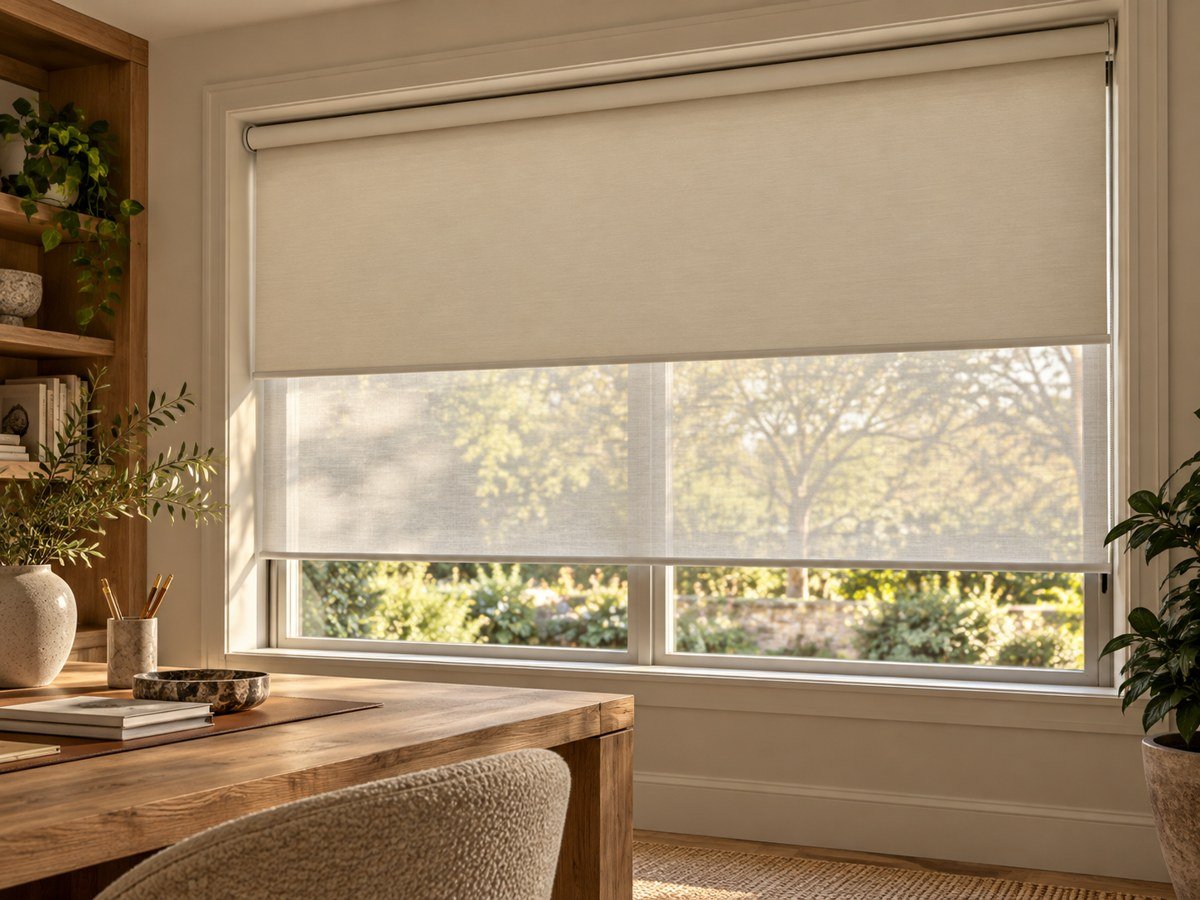

Keep the view.
Plan for after dark.
Solar shades do not provide dependable nighttime privacy. With indoor lights on and darker conditions outside, people may see into the room through the mesh. Even 1% openness is not a privacy guarantee.
Plan the nighttime privacy layer alongside your daytime view—or select a different fabric if you prefer one treatment.
Sources checked October 18, 2026. Research-based buying guidance; no hands-on privacy testing.

Why can people see through solar shades at night?
The lighting relationship changes: a view that is easier to see toward the bright outdoors during the day can become a view into your illuminated interior after sunset. The Shade Store explains this in its daytime and nighttime privacy guide.
Decide what you need to conceal: movement, silhouettes or recognizable detail. A window facing an empty garden and one facing a busy sidewalk need different conversations with the seller. A daytime showroom impression alone cannot answer that question.
Daytime example
An outward view may be easier to see. Check the actual view into the room; daytime privacy is not guaranteed.
Nighttime example
The room becomes the brighter side. The same fabric may now let someone outside see in.
1% vs 3% vs 5% solar shades: what changes?
For similar fabrics, a lower openness percentage generally gives a more screened view. Use 1%, 3% and 5% to compare that trade-off; they are not nighttime privacy scores. Color and lighting still matter.
On a narrow screen, scroll the table sideways to compare all four columns.
| Openness | Relative daytime view | A useful starting point when… | Night privacy alone? |
|---|---|---|---|
| 1% | Most screened of these three options. | You prioritize screening over a clearer view. | No guarantee. |
| 3% | Between the 1% and 5% options. | You want to compare an intermediate view. | No guarantee. |
| 5% | More open than 1% or 3%. | Preserving more of the view matters. | No guarantee. |
A directional comparison for similar fabrics, not a measured visibility test. Compare the exact color and fabric at your window. The Shade Store offers 1%, 3% and 5% sample options; Blinds.com explains the openness and nighttime privacy trade-off.
Buying takeaway: do not order 1% solely to fix an evening privacy problem. Put the nighttime treatment into the plan before choosing between solar samples.
Three ways to plan privacy after dark
Our suggested starting points depend on what you want to keep: the existing solar shade, a compact roller look or a simple daily routine.
For layering, see The Shade Store’s drapery and shade options. For a single treatment, see Blinds.com’s solar shade alternatives.
Check what “dual” means. Names vary. The Shade Store’s Double Roller Shades use alternating sheer and opaque bands. If you want a solar roller plus a separate blackout roller, ask explicitly for two independently operated fabrics.
Check the space before pricing both layers
Two treatments need a coordinated mounting plan. Record recess depth, window handles, the proposed front-to-back order and where each fabric will travel. Ask for the mounting requirements of the selected lift and top treatment.
A concrete depth example
The Veneta Designer Dual Roller Shades page lists these minimum depths for its cordless configuration, checked October 18, 2026.
This table applies to the named product and lift only. Scroll sideways on narrow screens.
| Top treatment | Published minimum depth |
|---|---|
| Without valance | 3½ inches |
| With valance | 4 inches |
Hypothetical 3¾-inch recess: it exceeds the first listed minimum by ¼ inch and falls short of the second by ¼ inch. Minimum mounting depth does not confirm a flush appearance, handle clearance or full fit. These figures do not establish the motorized requirements; obtain the seller’s confirmation for the exact configuration.
If darkness is also important, examine the finished edges. Blinds.com notes that inside-mounted blackout rollers can leave side light gaps. Read our blackout shade light-gap guide and inside vs outside mount guide before settling on the installation.
Build one complete quote: daytime fabric + nighttime treatment + controls + mounting hardware + installation + delivery and tax. Record what is included instead of comparing two starting prices. Use the 34 × 72-inch quote comparison method.
Check a sample with your evening lights on
This is our suggested buying check, not a laboratory test. A small swatch cannot reproduce the full shade, its edges or every viewing angle.
- Label the sample: fabric collection, color and openness, plus any proposed lining.
- Use the intended window: compare it in daylight and after dark with the lights you normally use.
- Check the relevant view: where safe and permitted, have someone look from an outside position similar to a neighbor or pedestrian’s view. Record visible detail, movement or silhouettes. Repeat with the proposed privacy layer closed where you can; request a full-size demonstration if available.
- Confirm the complete solution: discuss the results, uncovered edges and the second treatment with the seller before approving a custom order.
A seller request you can copy
“For [room/window], I need privacy after dark with [normal lights] on. Please confirm whether [exact fabric, color and openness] meets that use. If it needs a second treatment, list both fabrics, mounting depth, closed coverage, controls and the complete installed price. Explain any remaining visibility or light gaps.”
Common solar shade privacy questions
Can you see through 1% solar shades at night?
It is possible. The 1% label is not a promise of 99% nighttime privacy. A tighter weave does not establish complete privacy for an illuminated room; evaluate a suitable second layer if preventing inward visibility is essential.
Should I choose 1%, 3% or 5% for a bedroom?
Start with the room’s nighttime privacy and darkness requirements. Then decide whether a solar shade still has a useful daytime role alongside a separate treatment. The percentage comparison comes after that decision.
Will light-filtering shades prevent silhouettes?
Do not assume every light-filtering fabric behaves the same way. Ask the seller about the exact material and examine the sample with your intended lighting. State whether hiding silhouettes is part of your requirement.
Does blackout fabric make the whole window completely dark?
Fabric performance and installed coverage are different checks. Gaps at the sides or other uncovered areas can still admit light. Confirm the mount and any compatible gap-control accessories.
Will black solar shades solve nighttime privacy?
Do not choose by color alone. Phifer explains that dark fabrics can improve the outward daytime view, while indoor lighting can allow a view in after dark. Compare the actual fabric with your normal evening lights on.
Does “solar shade” mean solar-powered?
Here, solar describes the sun-control fabric. Motorization and the motor’s power supply are separate choices; the name does not mean a solar charging panel is included.
Sources & scope
Checked October 18, 2026. This guide combines official product information with our buying checklists; it does not report a hands-on privacy or installation test.
- Phifer: fabric color, openness and lighting contrast
- The Shade Store: solar shades at night and layering
- The Shade Store: solar fabric and sample options
- The Shade Store: Double Roller product terminology
- Blinds.com: solar shade openness and privacy questions
- Blinds.com: Veneta Designer Dual Roller specifications
- Blinds.com: roller and solar shade opacity, including light gaps
Explore our The Shade Store and Blinds.com buying profiles, or read how our research works.
Make the next decision.
If a second treatment is part of your privacy plan, confirm fabric, mounting space and the price of the complete setup.
Compare fabric opacity.
Review blackout, light-filtering and solar choices for the room.
Read the guide →
Check the mounting space.
Compare inside and outside mount before approving a layered setup.
Read the guide →Price the whole window.
Record both layers, controls and mounting work in your comparison.
Read the guide →Room images are AI-generated illustrations, not product tests or customer installations.
Prefer a woven texture? Read our woven wood shade liner and privacy guide before selecting the fabric.