

Find your Roman fold.
Flat shades show a smoother fabric face; front slat shades add horizontal pockets. Soft or hobbled folds retain overlapping loops, while relaxed shades have a curved lower edge.[1]
Use the shape to shortlist a style. Then check the exact fabric, lining, operating routine and window fit before ordering.
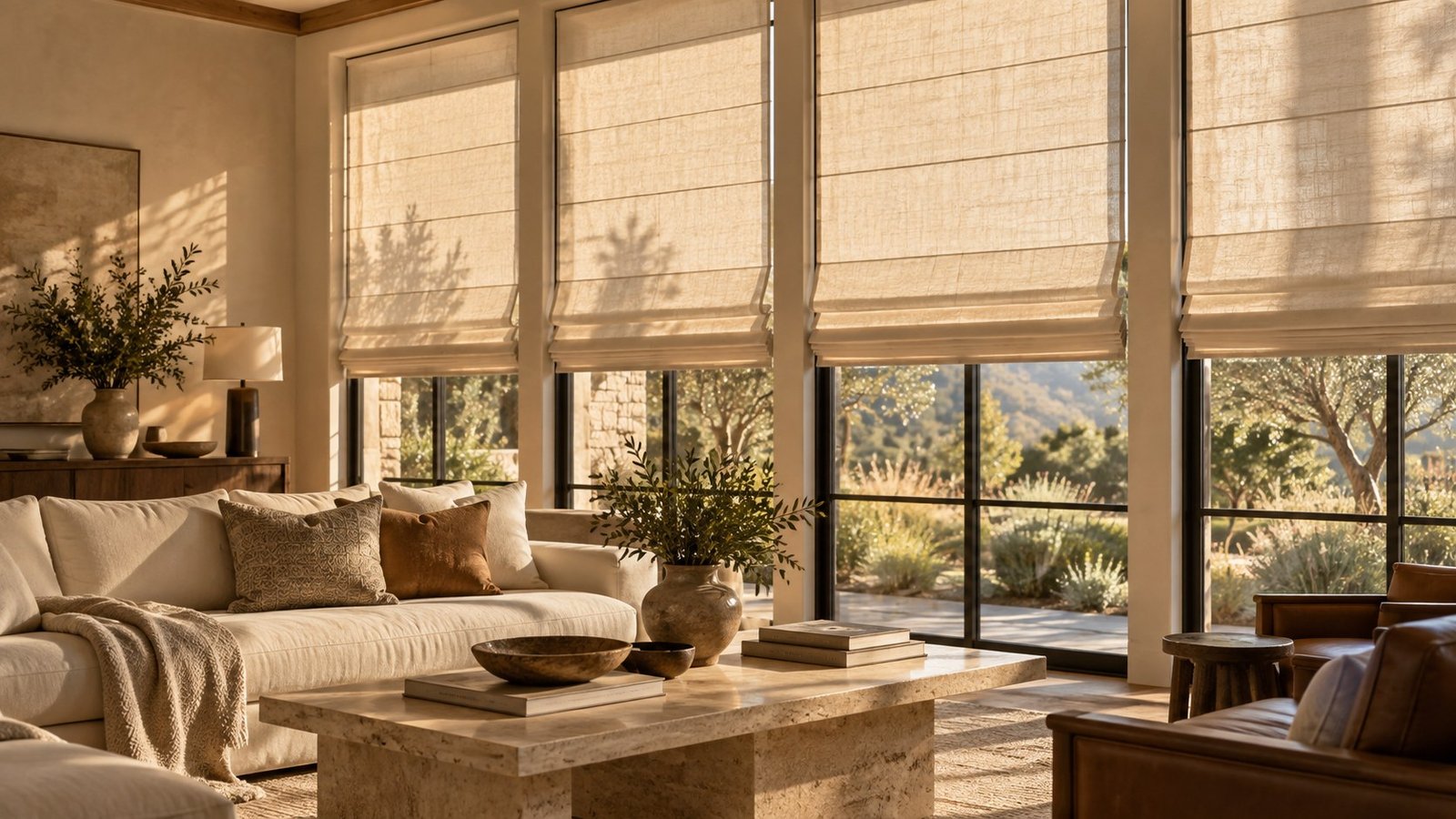
Research-based buying guidance. Sources reviewed October 19, 2026. We have not performed hands-on testing of these products. The featured room image is AI-generated inspiration; the diagrams below explain fold shapes.
Still deciding between a folded fabric shade and a rolled panel? Compare Roman and roller shades by room before choosing a fold.
Compare four Roman shade fold styles.
Original schematic illustrations. They show visual differences, not product dimensions or installation instructions.
Flat Roman shades
A flat or seamless style emphasizes the face of the fabric. It can be a useful starting point when you want a pattern to remain easy to read across the lowered shade.[1]
Compare: a full-length photograph in your chosen fabric, including the hem. A smooth-looking front does not tell you whether rods or seams sit behind it.
Ask: “Will my finished width need a fabric join, and where will it fall?”
Front slat Roman shades
Front slat construction places supporting stays in pockets on the face of the fabric. The result is a more pronounced horizontal rhythm than an uninterrupted panel.[1]
Compare: a front close-up and a side view. The Shade Store’s Aventura model, for example, uses visible front pockets with dowel inserts.[4]
Ask: “Are the pockets on the front or back, and what will I see in daylight?”
Soft or hobbled folds
Soft, hobbled styles keep overlapping fabric loops visible when lowered, giving the window more visual depth. This differs from a flat face that gathers as it rises.[2]
Compare: the complete shade at normal room distance. For a concrete product reference, The Shade Store describes its Pleated Roman as a hobbled construction.[5]
Ask: “How large is the raised stack for this fabric, liner, height and control?”
Relaxed Roman shades
A relaxed style has a soft, curved bottom rather than a straight lower line. Some sellers also use the term European fold.[2]
Compare: the curve when the shade is low, halfway up and raised. If the shape needs arranging by hand, decide whether that suits the way you will use the window.
Ask: “Can I see this exact shade rise and lower without anyone dressing the folds?”
Flat vs plain Roman shades: what changes?
Read the construction description alongside the name. In Blindsgalore’s Designer Roman Shades: Solids range, Plain Fold has structured pleats, while Flat Fold has no pleats across the face and locates its rods in the exterior-side lining.[3] Treat that distinction as a product-specific example, not a vocabulary rule for every seller.
Swipe the table to see all columns, or focus it and use the left and right arrow keys.
| Label you see | Verified example | What to confirm |
|---|---|---|
| Flat / Plain | Blindsgalore lists these as separate choices in its Designer Solids range.[3] | Are there face pleats, horizontal seams or visible rod pockets? |
| Front Slat | Blinds.com lists it separately from Flat Seamless and Classic Flat Pleat with Seams in its Luxury range.[7] | What front detail remains visible when the shade is down? |
| Aventura | The Shade Store specifies dowel pockets on the front.[4] | Does the front-pocket look suit your fabric and room? |
| Pleated | The Shade Store uses this name for a Roman style with uniform hobbled folds.[5] | Is the product a layered Roman construction or a different type of pleated shade? |
One window. One fabric. Two folds.
Suppose you like a printed fabric and will raise the shade each morning. Shortlist Flat and Soft/Hobbled, then request both with the same fabric, liner, window size and control.
- Compare fully lowered views to see how each fold presents the print.
- Watch both rise and lower without anyone arranging the fabric.
- Compare the quoted raised dimensions against the view you want to keep.
If an option is unavailable in one style, note the substitution before comparing the price. Add a rear view when lining or the street-facing appearance matters.
Which Roman styles suit daily use?
The Shade Store identifies Flat, Cascade, Aventura and Pleated as its everyday-use Roman styles. It positions Relaxed and Tulip as more decorative and says their folds need dressing after adjustment. Its listed motorized options apply to Flat, Cascade, Aventura and Pleated.[6] Check another seller’s exact product independently.
For a bedroom or office
Imagine the complete routine: lowering the shade, adjusting it during the day and raising it again. Check whether furniture blocks a manual control, whether you can reach the shade and how you would charge a selected motor.
Follow the model’s operation and installation instructions; a fold name alone does not establish suitability.
For a mostly decorative window
Decide what the shade needs to do after sunset and at different times of year. A styled room photograph may show only the position that looks best. Ask for the privacy configuration and the operating routine you will actually need.
Use our motor and hub guide to check the proposed control system.
Check the fabric in three ways.
Compare a neutral solid and a pattern in the same fold style. Hold the samples beside the wall, floor and any curtains in daylight and under evening lighting. Then ask for a full-size view to check how the chosen fold changes the pattern.
The design at full size
A small swatch answers a color question; it does not show your complete shade. Request a layout of any large pattern, border or fabric join. Blinds.com’s Luxury Roman page notes that many fabrics require vertical joins beyond a stated width, with fabric-specific exceptions.[7] Confirm the rule for the material and width in your own quote.
Privacy and room darkness
Ask for the fabric and lining combination, then evaluate coverage around the window. A blackout material does not by itself eliminate light around the shade’s edges.[1] Our blackout light-gap guide explains the separate coverage check.
Care and maintenance
Request the care sheet for both fabric and lining before choosing a cleaning method. Ask whether the assembled shade can be spot cleaned, whether professional cleaning is needed and how access works with your selected motor. Save those answers with the order.
Check raised stack, depth and projection.
Hartmann&Forbes’ Roman stacking guide varies its estimates by material and control system and shows adjustments for selected upgrades.[8] Use the dimensions for your exact configuration instead of assigning one stack size to every flat or hobbled shade.
Vertical clearance
Ask how far the entire raised assembly extends below a clearly defined top reference. Mark that position relative to the glass to understand the view you will retain.
Depth and projection
Check the model’s minimum mounting depth, fully recessed depth and clearance around handles or trim. These are different questions from how far the shade hangs down.
Continue with inside versus outside mounting or the Roman versus roller raised-clearance example.
Give the seller a complete brief.
Use one shortlist for the look and one checklist for the finished configuration. It is easier to compare two written specifications than two starting prices.
- Appearance: exact fold, fabric code, border and seam layout.
- Light: liner, finished coverage and how edge gaps will be handled.
- Fit: mount, manufacturer-directed measurements, bracket clearance and raised stack.
- Operation: control type, reach, charging access and any required hub.
- Order: complete price, installation responsibility, care instructions and applicable remake terms.
“Please quote the complete configuration.”
“I am comparing these two fold styles for the same window. Please confirm the fabric and liner, any seams, the control and required accessories, the fully raised dimensions and mounting requirements. Please also send lowered and raised views, the care instructions, and a total that lists every selected option.”
Common questions about Roman folds.
Are flat and plain Roman shades the same?
Not reliably across brands. Blindsgalore’s Designer Solids range distinguishes a pleated Plain option from its Flat construction. Check the exact product description and a lowered photograph rather than treating the names as interchangeable.[3]
What is the difference between flat and hobbled folds?
The main visual difference is the lowered face: a flat style presents a smoother panel, while a hobbled style retains overlapping fabric loops. Compare both in your fabric, then confirm the raised dimensions separately.[2]
How do front slat and flat Roman shades differ?
Front slat shades have visible horizontal pockets for supporting stays. A seamless flat style has a smoother face. Ask to see the exact product from the front and back, because the word “flat” alone does not confirm whether seams are present.[1]
Can a relaxed Roman shade be motorized?
Check the exact seller and model. The Shade Store’s collection lists motorization for Flat, Cascade, Aventura and Pleated, while describing Relaxed as decorative. That is not evidence that every other manufacturer offers the same combinations.[6]
Which Roman fold is best for a bedroom?
Start with the required privacy, darkness and daily operating routine. Then compare the fold shapes you like within products that meet those needs. Ask for the liner and coverage specification before deciding from a room photograph.
Does a flat Roman shade always have the smallest stack?
Do not assume that from the label. Ask for the finished raised dimensions for the actual height, material, lining and lift. A dimensional drawing is more useful than a general statement about the style.[8]
Build the rest of your shortlist.
Continue with our window shade brand guides or window shade buying guides to compare the complete order.
Sources & research scope
We reviewed manufacturer and retailer descriptions on October 19, 2026. The diagrams and buying checklist are our own explanatory material. Product examples apply only to the named ranges. This guide does not report hands-on testing, live prices or a ranked list of brands.
- Blinds.com glossary — Roman fold terms and light control.
- Blinds.com: Roman shade fold styles — visual distinctions between folds.
- Blindsgalore Designer Roman Shades: Solids — separate Plain, Flat and Soft options.
- The Shade Store: Aventura Roman Shades — front-pocket construction.
- The Shade Store: Pleated Roman Shades — hobbled fold construction.
- The Shade Store: Roman collection — decorative versus everyday operation and motor options.
- Blinds.com Luxury Roman Shades — style choices and fabric joins.
- Hartmann&Forbes Roman stacking guide (PDF) — configuration-specific stacking estimates.