
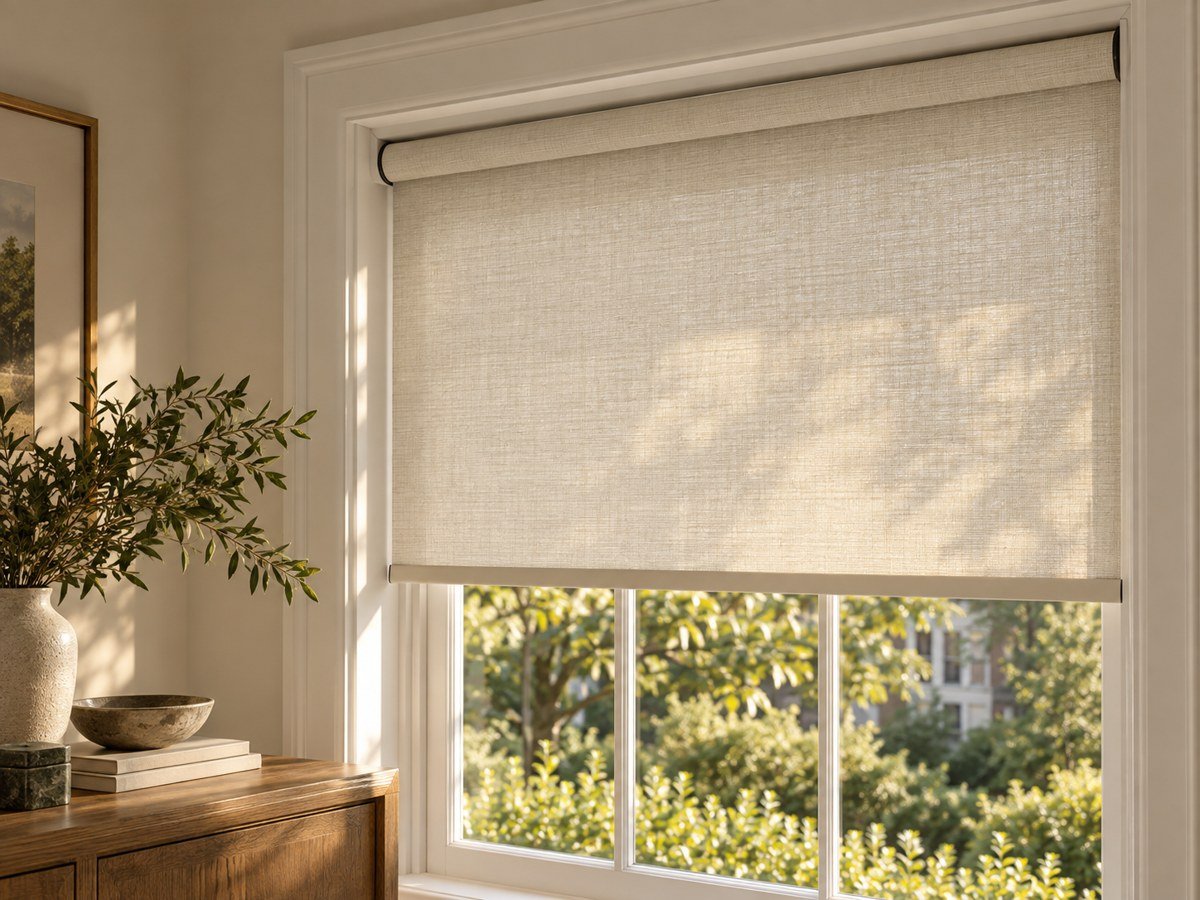


To measure for no-drill shades, first identify the exact product and mounting system. Record the window opening, usable depth, frame material and obstructions, then follow that product’s ordering instructions. Do not automatically use the smallest width or subtract a gap: those rules can differ between products.
Still choosing the product? Compare no-drill motorized shades from Blindster, SelectBlinds and Yoolax by mounting depth, frame fit and control package before applying the measuring instructions.

1. Identify how the shade attaches
Record whether the selected system uses tension or compression inside the frame, an adhesive mounting surface, or another mechanism. Find the model’s measuring and installation instructions before you take the order measurements. Confirm that the mechanism is offered with your chosen size, fabric and controls.
The words “no-drill” describe a purchasing category; they do not establish that every shade in it fits the same window or leaves the same removal result.
Mounting systems / Official sources checked October 13, 2026
Do all no-drill shades use the same measurements?
No. No-drill shades use different attachment systems. Tension headrails depend on the opening and mounting depth; a clamp system also depends on the frame profile it grips. Match the product, mounting option and instructions before converting your raw readings into order dimensions.
| Named option | Published mounting method | What to confirm at your window |
|---|---|---|
| SelectBlinds Click2Fit | Inside-mount tension system. Its guide advises against PVC frames and warns that width variation over ¼ inch can prevent a proper fit. Official Click2Fit guide ↗ | Frame material, depth and top/middle/bottom width readings. Follow the selected product’s order-width and rounding rules. |
| Blindster EZ-Mount on Motorized Deluxe Light Filtering Double Cellular | The checked configurator offers a tension-based headrail without screws or drilling. Official double-cell configurator ↗ | Whether EZ-Mount is available for the selected dimensions and controls, plus its depth, surface and ordering requirements. Do not borrow another brand’s deduction. |
| Yoolax Motorized Roller Shades No Tools No Drill | Clamps onto a compatible window or door frame. The product page lists a 0.2–0.83-inch frame condition. Official clamp-mounted roller ↗ | Have the seller identify the exact frame dimension and gripping surface on your window photo. This range is not the overall window-opening width. |
These are product-specific examples, not interchangeable installation instructions. We checked published options, not installed performance. The source links sit beside each claim so you can verify the current instructions.
2. Record your window before applying an ordering rule
| Record | What to note | Question for the seller |
|---|---|---|
| Opening width | Top, middle and bottom readings | Which reading should I enter for this mounting option? |
| Opening height | Left, middle and right readings | Which reading determines my order height? |
| Usable depth | Depth at the actual mounting position | Does it meet minimum and flush-mount requirements? |
| Frame or surface | Material, shape, condition and any slopes | Is this mechanism suitable for my frame? |
| Obstructions | Handles, cranks, locks and opening paths | Will the treatment clear them when installed and moving? |
Keep the raw measurements, a photo of the window and the exact product name together. This gives support enough context to confirm the correct ordering rule.
3. Use the product’s rule, not a generic deduction
A current example shows why the distinction matters. For the no-drill headrail option on SelectBlinds’ Select Blackout Roller Shades, the published instructions say to check widths in three places but enter the top width. They also list a 2½-inch installation depth, inside-mount-only use and a restriction against PVC frames. Those are requirements for that option, not every no-drill shade.
The same page describes a factory width deduction. Ask whether the size you enter is the opening size, headrail size or finished shade size. Do not apply a second deduction yourself unless the selected product’s instructions explicitly require it.
4. Separate minimum depth from a flush appearance
Ask two questions: will the shade install safely, and will the chosen headrail sit where you want it visually? The answers may involve different measurements. Record any projection beyond the frame and check its effect on nearby curtains, handles or trim.
5. Confirm installation, removal and order terms
Ask how the mechanism is tightened, adjusted and removed, and whether the frame or surface needs preparation. For a rented property, confirm the treatment is acceptable under your own agreement. Do not assume a no-drill label guarantees that any surface will remain unmarked.
Before paying, save the seller’s confirmation of your dimensions, mounting choice and frame suitability. Read custom-order cancellation, return and remake terms and identify who will handle a fit problem.
What if the window does not meet the requirements?
Ask about a different mounting system or shade configuration. A conventional inside or outside mount may involve different fixing requirements; use that product’s instructions and obtain any permission you need. Do not force a no-drill system into a window outside its published limits.
Continue your research
Explore no-drill shade brand profiles, the no-drill buying guide and measuring and ordering guidance. Compare complete configured totals in the price library.
Sources and research scope
Checked October 7, 2026: SelectBlinds product-specific measuring and mounting instructions and SelectBlinds measuring worksheet. This is an ordering checklist, not a substitute for the chosen product’s current instructions. Research methodology · Purchase-link disclosure.
Keep a separate record for every window
Give each window a simple label such as “Bedroom — left.” Keep its raw readings separate from the dimensions you eventually enter in the order.
| Record to keep | Before you submit the order |
|---|---|
| Window label and photo | Match the photo and measurements to one opening. |
| Raw width and height readings | Keep all readings, including their units and measuring positions. |
| Usable depth and frame material | Confirm the selected mounting system is suitable for both. |
| Exact product and no-drill option | Save the instructions for this option, size and control choice. |
| Entered order dimensions | Record which readings were used and whether a factory deduction applies. |
| Seller confirmation | Save the response about fit, obstructions and any unresolved measurement. |
Copy this request: “For window [label], I am considering [product and no-drill option]. My raw width readings are [top/middle/bottom], height readings are [left/middle/right], usable depth is [value], and frame material is [material]. Please confirm which dimensions to enter, whether the factory makes a deduction, and whether this system is suitable for the attached window photo.”
Common no-drill measuring questions
Do no-drill shades fit PVC window frames?
There is no universal answer. The checked SelectBlinds Click2Fit guide advises against PVC frames. Confirm suitability with the maker of the exact system; a different product’s no-drill label does not establish compatibility. See the source-linked mounting comparison.
Are clamp-mounted shades measured like tension shades?
Do not transfer the same rule between them. Tension systems fit within an opening; clamps must grip a compatible frame profile. Keep opening dimensions and any required frame measurement separate, and ask the seller which readings determine the order.
Should I automatically use the smallest width?
Use the exact product’s rule. Save all readings and ask the seller which one determines the order width for the selected mounting option.
Should I subtract clearance before ordering?
Confirm whether the factory makes a deduction and what the order dimensions represent. Apply only the deduction explicitly required by the chosen product’s instructions.
Can I copy one window’s measurements to the next?
Measure and label each opening separately. Keep the product and measuring rule consistent, but record the actual readings for each window.

Blindster vs SelectBlinds
Compare the named no-drill options, motor packages and remake terms after you have confirmed your frame and measurements.
Compare Blindster and SelectBlinds →Turn your measurements into a shortlist.
Confirm window fit first, then review coverage and compare the complete configuration.
Inside or outside mount?
Compare mounting space, handles and coverage for the window.
Read the guide →
Plan bedroom darkness.
Check light gaps alongside the chosen blackout fabric.
Read the guide →
Compare a complete quote.
Include the exact mount, controls and accessories in the total.
Read the guide →